What's constraining China's electric truck corridor buildout?
Electric heavy trucks are now half of China’s sales. Building the charging network they need is proving harder.

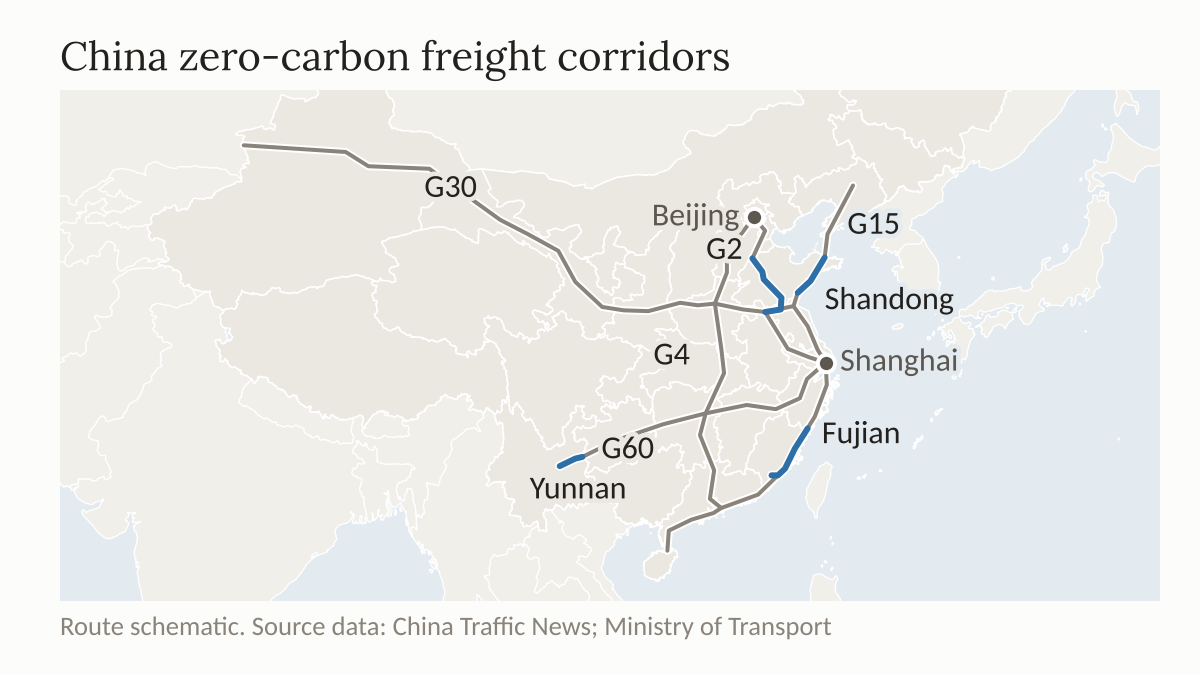
China’s first five “zero-carbon” freight corridors aren’t new roads. They are charging and battery-swap networks for electric heavy trucks along existing expressways, and power supply and land are holding them back, China Traffic News (中国交通报) reported Nov. 14. The five run about 11,100 km (6,900 miles) across 16 provinces and are planned to carry 269 stations. Only parts are running, thanks to three major constraints:
- Grid capacity. Substations upstream of the planned stations often lack spare capacity, the paper said. The National Development and Reform Commission pays 20% of approved investment in corridor stations, grid upgrades and operating systems.
- Land availability. Existing expressway service areas often don’t have room for large charging and swap stations, according to the paper.
- Issues with swap stations. Trucks built to swap batteries “still struggle to squeeze into trunk-line logistics,” mainly because swap stations along expressways remain scarce, trade site 第一商用车网 cvworld.cn said Oct. 23. Swap trucks made up 22.9% of China’s battery-electric heavy-truck sales from January through September, the site said.
Progress so far is uneven. In Shandong, 12 stations operate on the Beijing-Shanghai Expressway (G2) and four are built on the Shenyang-Haikou Expressway (G15), of 34 planned there. Fujian’s G15 section has run 23 since Oct. 1, as we reported at its opening. A Yunnan section of the Shanghai-Kunming Expressway (G60) has six. The paper gave no counts for the G4 and G30 corridors.
There’s a lot riding on the network. A plan dated May 29 from the Ministry of Transport (交通运输部) and 10 other agencies calls for 30,000 km of corridors and about 3,000 heavy-truck charging and swap stations by 2030. By our calculation, the first five corridors are more than a third of that length, but they will carry less than a tenth of those stations. Meanwhile, trucks with electric and other new power systems rose from 29% of China’s heavy-truck sales in September 2025 to 50% a year later, Cui Dongshu (崔东树) of the China Passenger Car Association (乘联分会) said, according to Yicai (第一财经).
Sources
- 中国交通报 China Traffic News
- Ministry of Transport and 10 agencies (gov.cn, 交规划发〔2026〕52号)
- 第一财经 Yicai
- 第一商用车网 cvworld.cn (via Sina Finance)
Editor: Ian Lamont