China orders AI cameras to track coal miners and overproduction
Regulators are fast-tracking the new system following a deadly mine blast in May.

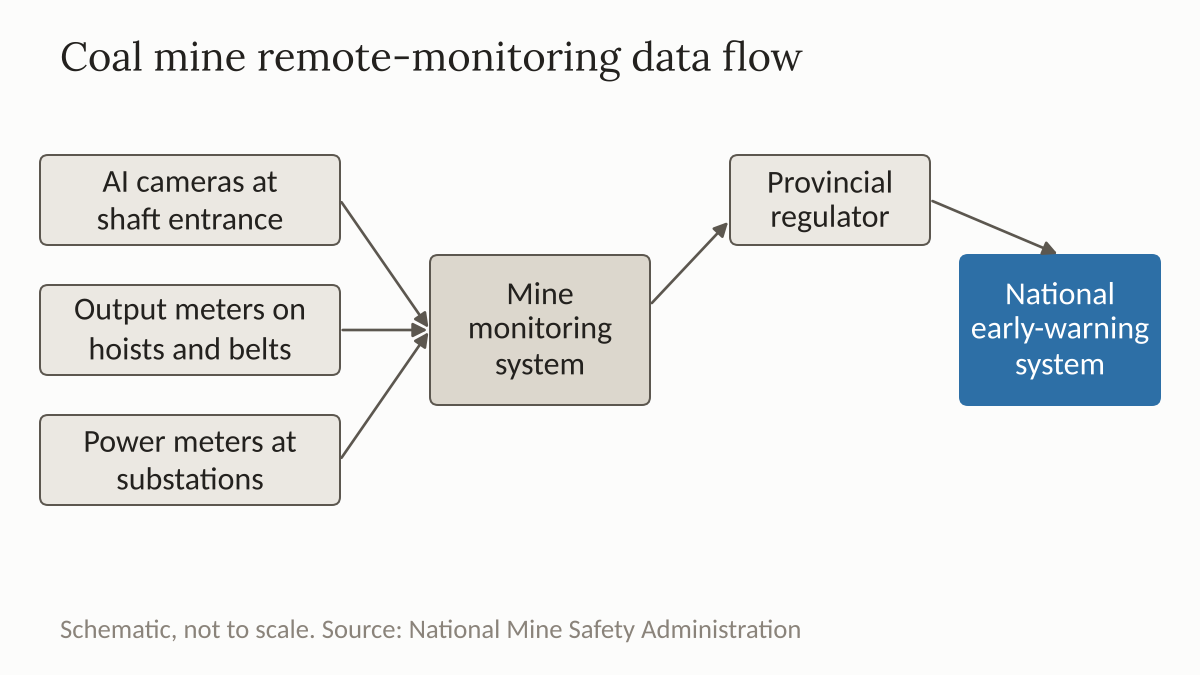
China's mine-safety regulator has ordered underground coal mines to fit AI cameras that count miners going underground, and meters tracking output and power use, feeding a national early-warning system by the end of June 2027. The regulator says it wants a remote, automated crackdown on illegal mining.
The National Mine Safety Administration (NMSA, 国家矿山安全监察局) signed the notice on Nov. 4 and published it on Nov. 9. It covers producing mines and construction mines whose second-phase works are finished. It cites the May 22 gas explosion at the Liushenyu coal mine (留神峪煤矿) in Changzhi, Shanxi province, which killed 82 people and left two missing, local officials told a briefing reported by Xinhua (新华社).
Each mine needs three systems:
- Two or more new or upgraded cameras at each shaft entrance count people in and out, with an alarm, as a rule, when the AI count of people underground differs by more than 10 from the miners' location-tag system.
- Meters on hoists and belts, or scales and weighbridges, track output, with an alarm, as a rule, when three straight months' output exceeds 30% of the mine's approved capacity, or a year's exceeds 110%.
- Meters at substations log underground power use.
The NMSA says it aims to use the data to spot miners going underground without location tags, mines producing beyond capacity, mines that claim to be idle while working, and concealed coal faces. Jiemian (界面新闻) reported after the blast that Liushenyu's actual underground headcount didn't match its posted figure.
"System makers may not give coal mines permissions or passwords that can alter back-end data," the notice said. Mines pay, charging the cost to their work-safety funds, and parent companies or local regulators may buy in bulk to ease the burden.
The notice doesn't say how many mines must comply. China had about 4,000 coal mines, open-pit included, by end-2025, the National Energy Administration (NEA, 国家能源局) told Xinhua. Overproduction was already a target. In July 2025, The Paper (澎湃新闻) reported that the NEA had ordered checks on whether producing mines in eight provinces exceeded their announced capacity, saying some were offsetting falling prices with higher output.
Sources
Editor: Ian Lamont