Taiwan writes “non-red” drones into law, aiming at defense and export markets
A new law defines a supply chain free of mainland China, backs it with NT$240 billion and makes a parts-grading guideline binding on government buyers. US defense rules push the same way.

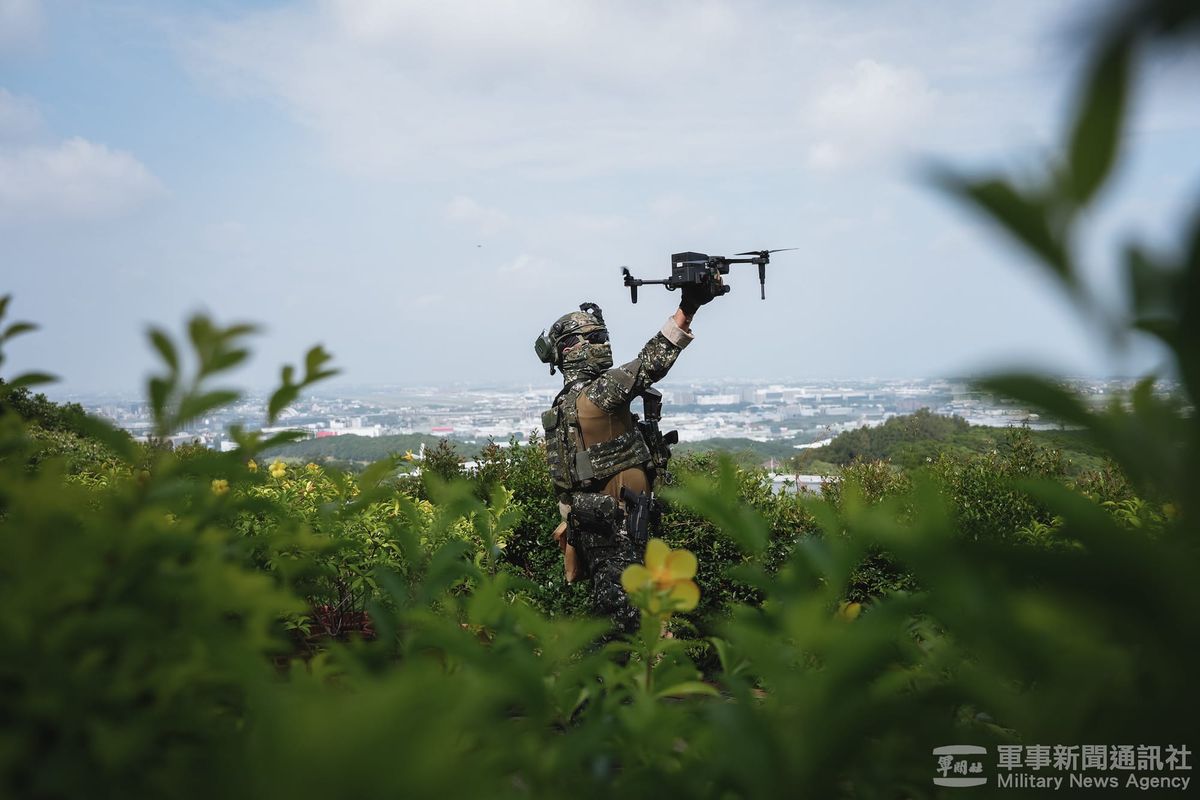
“Non-red” (非紅) is Taiwan’s shorthand for drones and parts free of mainland Chinese companies, money and components. Taiwan’s cabinet has set 2027 as its target for a fully non-red drone supply chain.
Taiwan’s drone law, passed in August, gives the idea legal form under another name. It defines a “trusted supply chain” (可信任供應鏈): drone systems, key parts and materials whose sources, supply and cybersecurity meet the government’s security requirements. It commits NT$240 billion (about US$7.5 billion) over six years, with NT$40 billion (about US$1.3 billion) a year as the baseline.
What does Taiwan's drone law want?
Taiwan's drone law has three goals:
- Defense self-reliance: the defense ministry is to buy low-cost, high-performance Taiwan-made drones first.
- Industrial upgrading. The law’s stated purpose includes steering Taiwan’s information technology and precision-machinery makers into defense and drones.
- Exports, which the law supports with market development, financing, tax incentives and other help.
Companies best known for other products are already moving in. Taoyuan cable maker Y-S Electronic (詠昇電子) won a training-drone contract in October that barred mainland-funded bidders. Projector maker Coretronic (中強光電) moved its drone maker directly under its new parent. Taichung-based Thunder Tiger (雷虎), which makes radio-controlled models as well as drones, qualified for all six items of a government drone contract. Taipei printer maker Teco Image Systems (東友科技) won a transport-drone slot in November.
How is Taiwan's drone law enforced?
The law requires government drone contracts to follow a procurement guideline and to bar companies from mainland China, Hong Kong and Macau. Procurement teams also may not include people from those places.
The guideline, issued in January by the Public Construction Commission (行政院公共工程委員會), the cabinet’s procurement regulator, grades a drone and each of its parts from A to D by maker, brand and origin. Grade A means all three are Taiwanese. Grade C allows foreign makers, brands and origins, but nothing from mainland China, Hong Kong or Macau. The guideline sets grade A for the whole drone, its airframe and its motors. Batteries, flight-control chips and thermal imagers may be grade C.
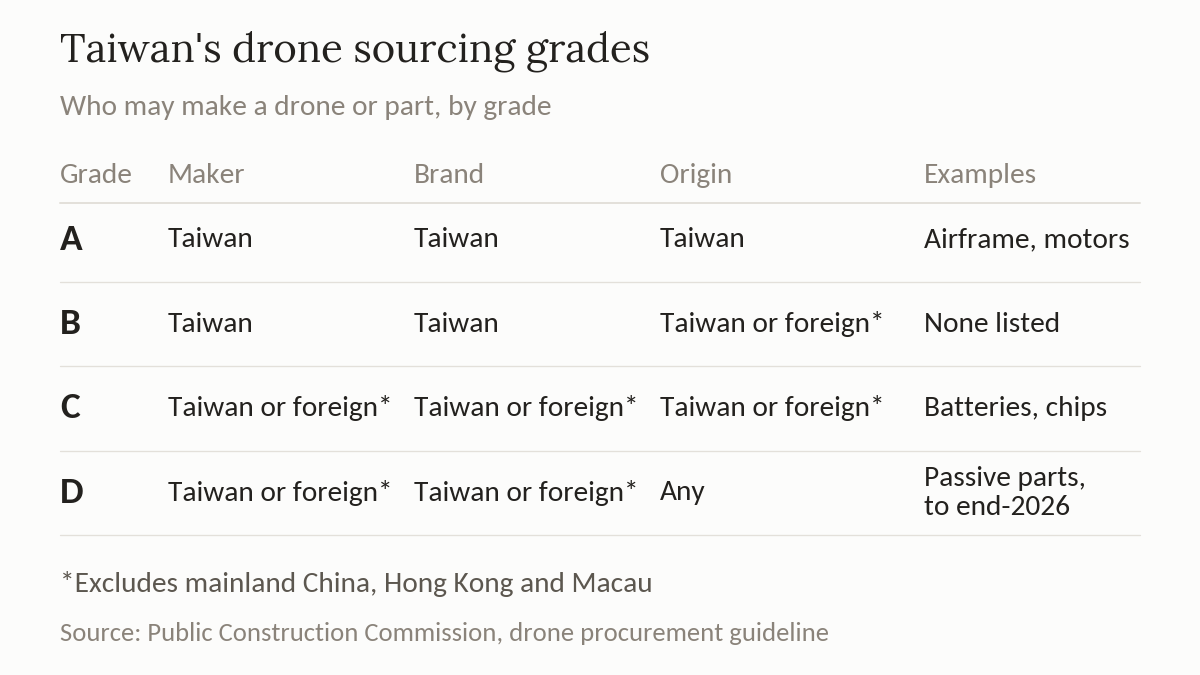
Grade D, the loosest, still requires a maker and brand from outside mainland China, Hong Kong and Macau, but lets the part itself be made there. The guideline allows it only as a stopgap, for parts with no cybersecurity risk that Taiwan’s supply chain cannot yet source fully outside China: capacitors, resistors and other passive components, as well as lenses and magnets. Drones delivered by the end of 2026 may use grade D for these parts. From Jan. 1, 2027, they must meet grade C, which the guideline calls fully non-red. That deadline falls before most of the drone law takes effect in March.
Agencies may accept a drone on a certificate of origin, a signed non-red declaration and a parts list naming each part’s origin. If import papers look false, they can take the drone apart.
The guideline already applies to tenders. Most of the law takes effect March 11, 2027. It orders the Ministry of Economic Affairs (經濟部) and the Ministry of National Defense (國防部) to set up tiered certification for civil and military drones. Companies seeking the law’s incentives for local production will need that certification. No implementing rules had been listed by Oct. 30.
What do foreign buyers require?
The US, Taiwan’s biggest defense partner, has its own rules. Since 2019, US law has barred the Pentagon from buying or operating drones made in China, or drones that use Chinese-made flight controllers, radios, data links, cameras, gimbals, ground-control systems or operating software. The Pentagon’s Drone Dominance Program goes further, with phased sourcing rules for parts including motors, batteries and the magnets inside motors, Inside Unmanned Systems reported. In December 2025, the US Federal Communications Commission put all foreign-made drones and key drone parts on its Covered List, Taiwan’s included. Drones and parts on the Pentagon’s Blue UAS list are exempt until Jan. 1, 2027.
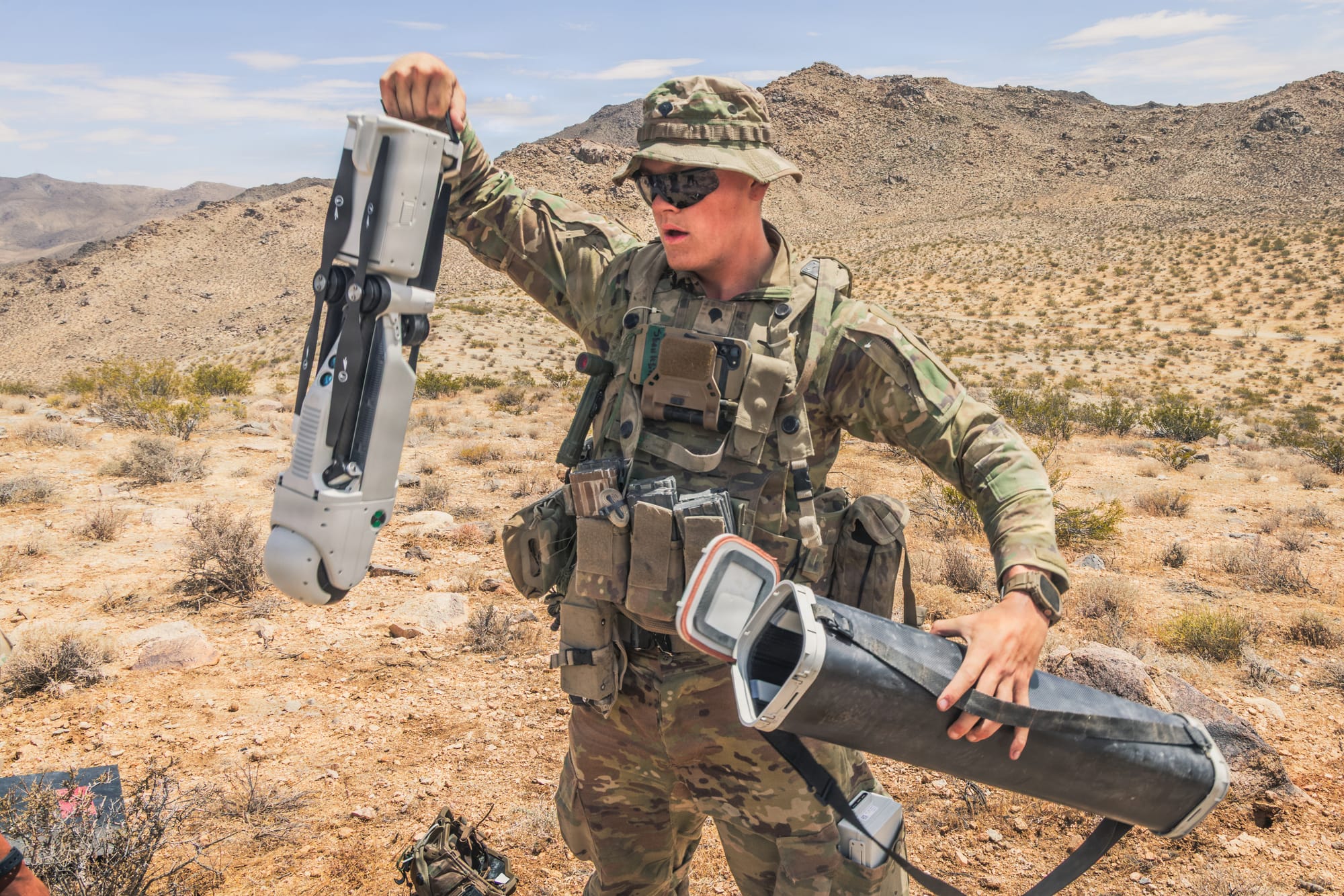
Taiwan is aligning with those standards. Its drone cybersecurity rules recognize Green UAS, a US industry group’s drone certification. The Industrial Technology Research Institute (工業技術研究院) became the first Green UAS assessor outside the US in June. We found no Taiwan-US mutual certification deal.
US defense companies are coming to Taiwan. In May, 41 US defense, AI and electronics companies, including Anduril and BAE Systems, visited for a Taiwan-US defense industry forum focused on drone, cybersecurity and satellite communications supply chains, TechNews reported (科技新報). Thunder Tiger says its team with Taiwan’s Rehfeldt Group (來福集團) and US firm Farage Precision placed 11th in the first phase of the Drone Dominance Program and has delivered a first order of 1,520 drones, CNA reported (中央社) in October. The state-run National Chung-Shan Institute of Science and Technology (國家中山科學研究院) developed its armed Chien Feng IV (勁蜂四型) drone with US contractor Kratos, adapting Kratos’s MQM-178 target drone, Taiwan News reported.
Who’s buying?
Finished-drone exports rose to US$93.4 million in 2025 from US$4.41 million in 2024, the economics ministry said, as reported by TechNews and Anue (鉅亨網). In the first half of 2026 they reached US$212 million, the ministry said in July. The Czech Republic, Poland and the US took 90% or more of 2025’s exports, the Executive Yuan (行政院), Taiwan’s cabinet, said in January. Since Russia’s invasion of Ukraine, the Czech Republic, Poland and Lithuania have wanted more dual-use drones and are looking for suppliers outside China, the economics ministry said in April.
Japanese drone maker ACSL buys battery parts from Taiwan, its co-chief executive told the Liberty Times (自由時報) in July. US drone makers Skydio and Anduril have found partners in Taiwan, Chiou Chyou-huey (邱求慧), who heads the economics ministry’s Industrial Development Administration (產業發展署), told reporters in May, Business Today (今周刊) reported.
How is Taiwan incentivizing the nascent industry?
Taiwan’s incentives work mainly through procurement, not subsidies. The defense self-reliance and unmanned-vehicle industry law, passed Aug. 27, commits NT$240 billion over six years, paid out through annual budgets.
The first concrete demand channel we have reported is a Bank of Taiwan joint supply contract for nine ministries, with a NT$1.048 billion budget across six drone items. Any agency, school or state firm may order from it, and qualifying for the catalog guarantees no orders. The contract’s terms also decide who can compete: as we reported Oct. 19, it barred mainland-funded bidders.
Exporters are being nudged too. As we reported Oct. 28, they were told to prepare for a pending US tariff break.
What does it cost?
Once China is taken out of the drone procurement process, costs rise.
Some non-red items cost only about 30% to 50% more than “red” ones, Chiou said. The price gap with Chinese consumer drones such as DJI’s may be several times or more, Chiou said. For high-end drones that resist jamming and fly themselves, Chiou saw a chance of narrowing it to within two times.
We found no published per-part cost comparison from any company, official or research firm.
Sources
- 行政院公共工程委員會 Public Construction Commission, 遙控無人機採購作業指引 (copy hosted by Yuan Ze University)
- 全國法規資料庫 Laws & Regulations Database, 強化國防自主暨無人載具產業發展條例
- 行政院 Executive Yuan
- 行政院 Executive Yuan
- 科技新報 TechNews (relaying MOEA)
- 鉅亨網 Anue (relaying MOEA)
- 今周刊 Business Today
- 自由時報 Liberty Times
- 雷虎 Thunder Tiger (TWSE material information)
- 全國法規資料庫 Laws & Regulations Database, search result (no implementing rules listed; updated 2026-10-30)
Editor: Ian Lamont