Taiwan adds border checks for e-scooter chargers and battery-swap gear
Taiwan's standards bureau took responsibility for charging and swap stations after a series of fires.

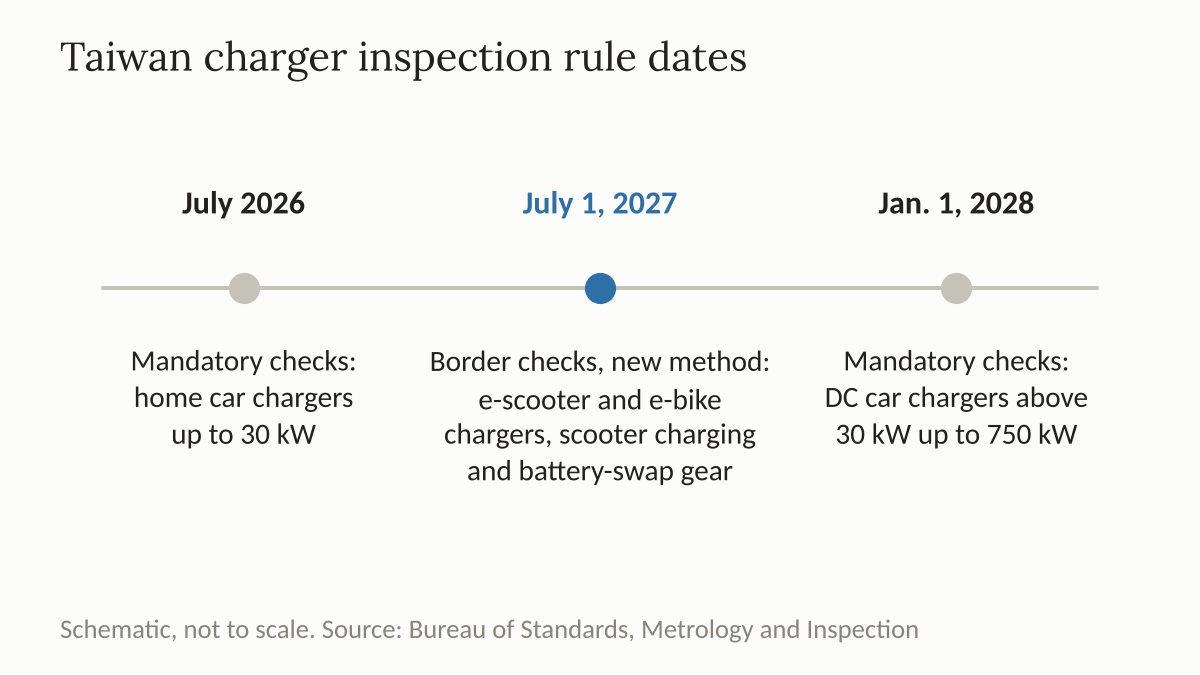
Taiwan will check chargers for electric scooters, e-bikes and pedal-assist e-bikes, and scooter charging and battery-swap equipment, at the border from July 1, 2027. From that date, each product must be certified by registration, or type-approved and inspected batch by batch, before it is imported or leaves the factory. The current method then stops. The Bureau of Standards, Metrology and Inspection (BSMI, 經濟部標準檢驗局) says the products carry higher safety risk.
The notice, dated Nov. 6, 2026, took effect at once. Border control means the products are checked at import. The change is meant "to strengthen how they are managed and effectively regulate how businesses control product quality," the notice said. Makers and importers have been able to apply since the notice was issued. Certificates issued before July 1, 2027 run until June 30, 2030, and later ones for three years.
The same notice also adds direct-current car chargers rated above 30 kilowatts and up to 750 kilowatts, which face inspection from Jan. 1, 2028. They carry higher risk and are widely installed in outdoor parking lots and rest stops, the bureau says. It had announced the 2028 date in a Sept. 9 release that set out a move from voluntary certification of car chargers, offered since 2013, to mandatory checks, starting with home chargers rated up to 30 kilowatts in July 2026.
Swap-station safety has been on the government’s radar for years. In 2019, after a battery burst out of a Gogoro swap station in Taichung and another station in Taoyuan caught fire, the Executive Yuan’s consumer protection office named the economics ministry the authority responsible for charging and swap stations. Neither incident injured anyone.
The bureau's head, Chen Yi-ling (陳怡鈴), explained in September why it checks home car chargers before they leave the factory. "If it's in someone's home, I have no way to go in and inspect it," she told Public Television Service (公視新聞).
Mainland China has set a similar rule for e-bike chargers. Its State Administration for Market Regulation (市场监管总局) said in 2024 that from Nov. 1, 2025, they would need compulsory product certification (CCC) before they could leave the factory, be sold or be imported, according to People's Daily (人民日报).
Sources
- 經濟部標準檢驗局 Bureau of Standards, Metrology and Inspection (notice 經標檢政字第11530021020號 and attachment, via TEEMA)
- 經濟部標準檢驗局 Bureau of Standards, Metrology and Inspection (testing information platform)
- 經濟部標準檢驗局 Bureau of Standards, Metrology and Inspection (news release)
- 公視新聞 Public Television Service
- 人民日报 People's Daily
Editor: Ian Lamont