Prices for big "all-in-one" LED screens are dropping fast in China
A survey of 20 makers finds the screens now within reach of well-funded government and corporate buyers, though still pricier than alternatives for schools and small firms.

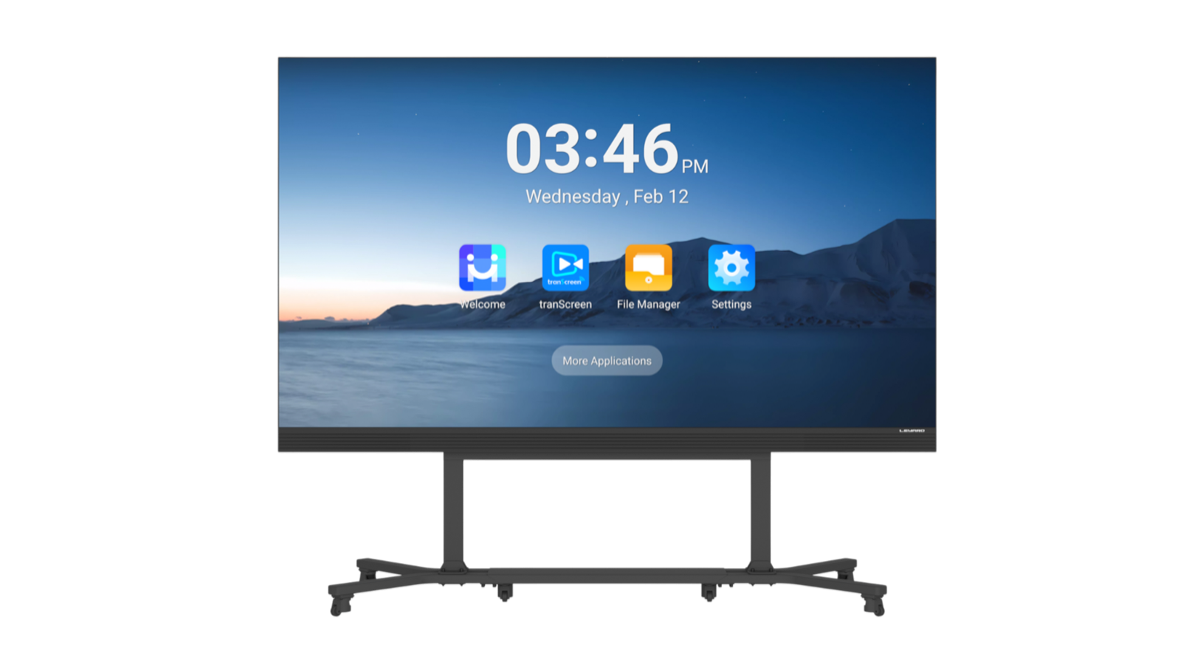
Big LED screens sold as ready-made units for meeting rooms are getting cheaper in China, according to a survey of 20 leading makers by Hi-Tech Talk (行家说), a Guangzhou industry-research and media firm. But the makers disagree on whether they can yet compete on price with LCD screens and projectors.
An LED all-in-one is generally a direct-view LED screen with its own built-in system, rather than a video wall assembled on site, though the survey says the industry has no common definition or interface standard. Hi-Tech Talk says in its 2026 survey report that the end price of a 135-inch, 2K-resolution all-in-one fell from more than 200,000 yuan (about US$30,000) earlier to under 100,000 yuan (about US$15,000) now, less than half the earlier price. The report doesn't say when the higher price applied. It credits better yields in chip-on-board (COB) packaging and a maturing supply chain.
Skyworth's (创维) commercial-display business told the survey that a 135-inch model now sells for 80,000 to 120,000 yuan (about US$12,000 to US$18,000), level with a high-end LCD video wall plus installation. Leyard (利亚德), an LED video wall maker, said rising COB yields have brought 135- and 138-inch models down to about 100,000 yuan. But Ledman (雷曼光电), a Shenzhen maker, said LED all-in-ones still cost five to 10 times as much as projectors in the 10,000-yuan (about US$1,500) class and 86- or 98-inch LCD interactive panels. Unilumin (洲明科技), another video wall maker, said price is still the main obstacle to wider use in China.
The survey itself finds that prices are now within reach of well-funded government and corporate buyers, but cost-sensitive small and midsize businesses and schools still face a price gap against projectors and LCD video walls. Falling prices have also brought cheap "module plus bracket" products into the market, which the report says may hurt the industry's reputation. Skyworth said some makers pass such kits off as all-in-ones.
The products are still spreading. Hi-Tech Talk said in a separate report that the main makers' all-in-one shipments grew in the first half of 2026. Research firm TrendForce projects in its global LED video wall outlook that all-in-one shipments will top 17,000 screens in 2026, as use spreads beyond meeting rooms into education, training and retail.
Sources
- 行家说 Hi-Tech Talk (via OFweek 维科号)
- 行家说 Hi-Tech Talk (格隆汇 Gelonghui column)
- 行家说 Hi-Tech Talk (格隆汇 Gelonghui column)
- TrendForce
- 行家说 Hi-Tech Talk (about page)
- Leyard Europe (M135 product page)
Editor: Ian Lamont