Power-equipment makers join China's elite smart factories
Plants named to Beijing's top tier must apply AI in at least 60% of their use cases.

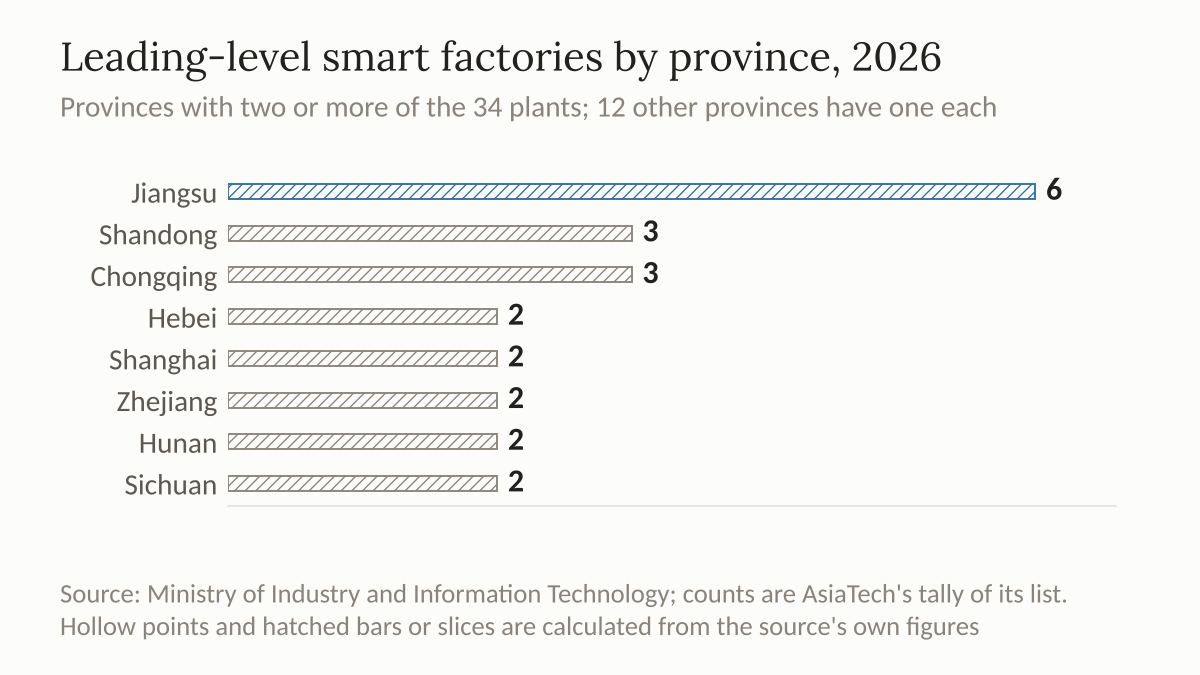
China's government has named 34 plants to the top tier of its smart-factory program, more than twice the 15 in its first batch in 2025, bringing the total to 49. Judging by their project names, three of the new plants belong to makers of power-generation equipment and two to makers of grid equipment such as ultra-high-voltage transformers. No such maker was on the 2025 list.
The Ministry of Industry and Information Technology (MIIT, 工业和信息化部) and five other agencies issued the "leading-level" (领航级) list in a notice dated Nov. 17, announcing it on Nov. 19. Leading-level is the highest of four tiers. To qualify, a plant must apply AI in at least 60% of its use cases, Xinhua (新华社) reported, citing the 2026 criteria. The notice calls it a "cultivation list": the plants are chosen to be built up, not certified as finished. Jiangsu has six of the 34 plants, the most of any province, by our count of the list.
Together, the new plants apply AI in more than 70% of their use cases, have developed more than 1,000 industrial AI agents and use more than 300 million tokens (the units AI models read and write) per day, Xinhua said, citing statistics from the announcement. AI is spreading from supporting roles into design, production and management, Xinhua said.
The tiers below are far wider. China has built more than 60,000 basic-level, 13,000 advanced-level and 750 excellence-level smart factories, Shanghai Securities News (上海证券报) reported from the conference.
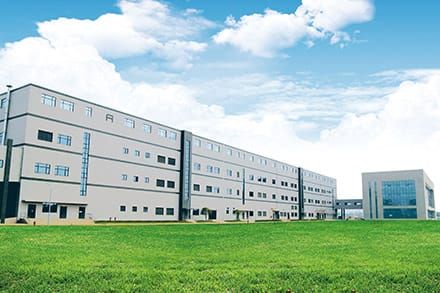
One of the power-equipment plants is a turbine-generator factory in Shanghai run by Shanghai Electric Power Generation Equipment (上海电气电站设备有限公司), a unit of Shanghai Electric (上海电气). The company said in a release reported by jc35 (机床商务网) that it will finish building the plant to the leading-level standard by the end of 2028. It also claims:
- The domestic-content rate of the plant's core products has reached 100%.
- Its research-and-development cycle is 47% shorter, though it gave no baseline.
- Its on-time order delivery has stayed at 100%.
Sources
- 工业和信息化部 Ministry of Industry and Information Technology (notice)
- 工业和信息化部 Ministry of Industry and Information Technology (2026 list)
- 工业和信息化部 Ministry of Industry and Information Technology (2025 list)
- 新华社 Xinhua
- 新华社 Xinhua (via ncsti.gov.cn)
- 上海证券报 Shanghai Securities News (via China Youth Online)
- 机床商务网 jc35 (Shanghai Electric release)
Editor: Ian Lamont