China cell tower landlord turns to drone services
China Tower reported revenue from telecom carriers fell 6% in the first 9 months of 2026 compared to a year earlier.

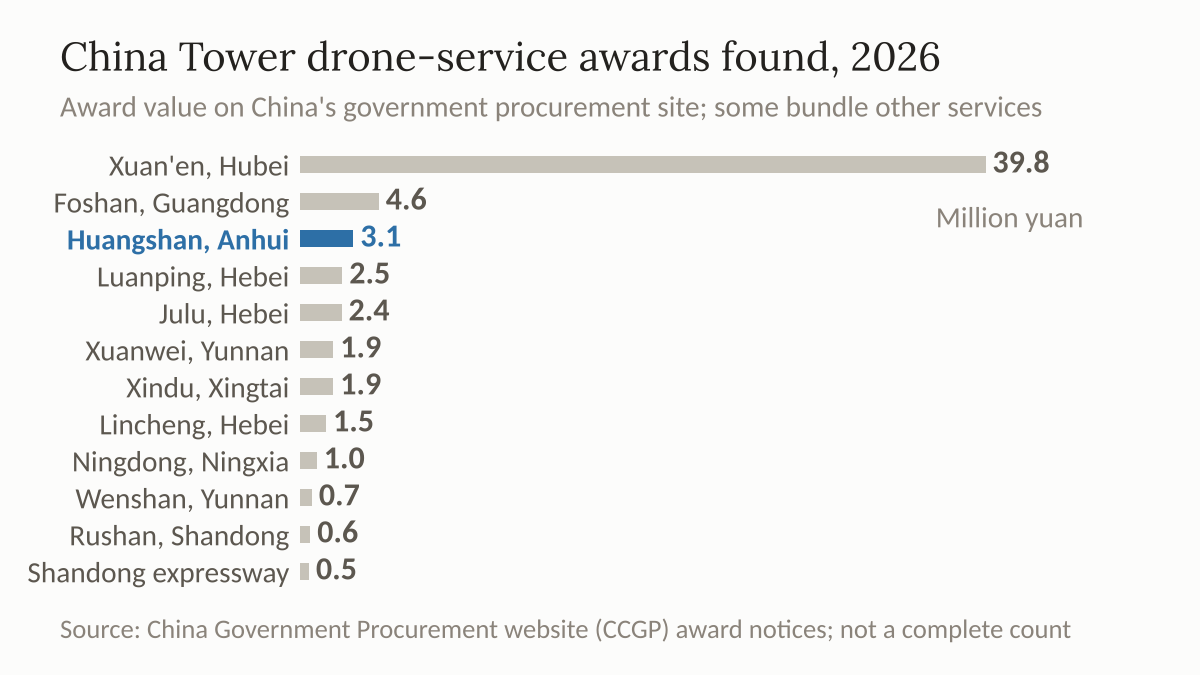
China Tower, a Beijing-based, Hong Kong-listed landlord of about 2.2 million telecom tower sites at the end of June, is selling drone patrols to government agencies as revenue from its carrier customers falls. Its latest win is a 3.1 million yuan (about US$462,000) award for geological-hazard patrols in Huangshan, a city in eastern China's Anhui province. A check of China's government procurement site found at least 12 awards in 2026 for drone or low-altitude services won by China Tower or its branches, in seven provinces and regions.
The buyer, Huangshan's natural resources and planning bureau (黄山市自然资源和规划局), wants automated drones on standby around the clock, the award notice says. China Tower didn't win on price. Two of its four ranked rivals bid less, the final ranking shows, but scored 41 and 28 on the non-price part of the evaluation, against China Tower's 85. The Huangshan branch of carrier China Telecom, the highest bidder, finished fourth.
The 12 awards ranged from 526,000 yuan (about US$78,000) to about 39.8 million yuan (about US$5.9 million), and the largest also covers video monitoring and services to track and counter drones. Several pay for automated drone docks, bases that store and launch drones. In Xingtai, in northern China's Hebei province, 1.9 million yuan (about US$290,000) buys eight docks to cover the "blind spots" of tower video cameras.
China Tower says it mounts drone docks on its towers. In southern China's Guangdong province, it says it has deployed 1,345 drone hangars covering 1,542 towns and urban subdistricts, China News Service (中国新闻网) reported in July.
In its core business, revenue from telecom carriers fell 6% from a year earlier to 59.6 billion yuan (about US$8.9 billion) in the first nine months of 2026, China Tower said in results reported by the trade site C114. Revenue from Smart Tower, the business line where it says it is speeding up low-altitude work, rose 10.9% to 7.9 billion yuan (about US$1.2 billion), but China Tower's 2025 annual report and first-half results give no low-altitude revenue figure.
Beijing is also pressing those carriers on low-altitude airspace. In February, the Ministry of Industry and Information Technology and four other departments told them to strengthen communication, navigation and surveillance below 300 meters (about 1,000 feet), Caixin reported.
Sources (18)
Editor: Ian Lamont