Japanese city halts self-driving L2 bus trial after wall collision
Built for driverless operation but run with a safety driver, the shuttle touched a stone wall on its first public day.

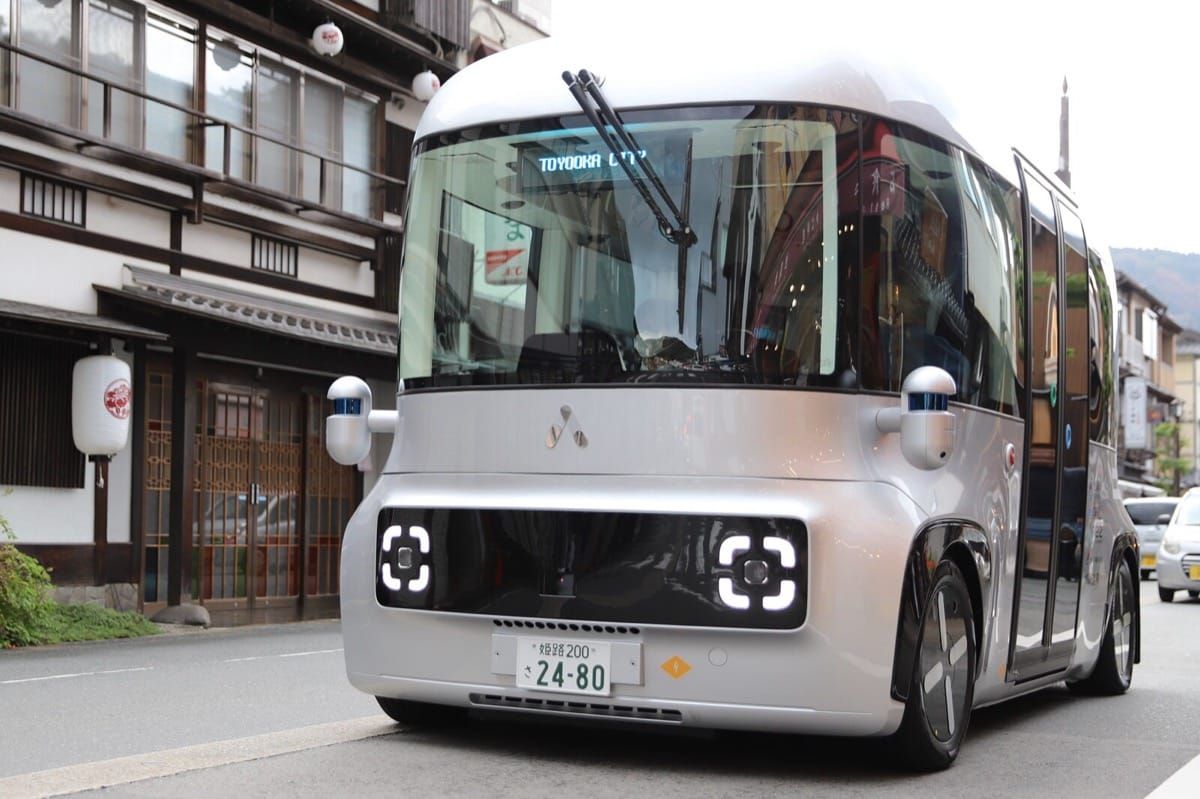
A self-driving shuttle made by South Korea's Autonomous A2Z (오토노머스에이투지) touched a stone wall in Kinosaki Onsen, a hot-spring town in Toyooka, in Japan's Hyogo Prefecture, on Nov. 9, the trial's first day carrying the public. Toyooka City (豊岡市) suspended the service until an investigation confirms it is safe. None of the eight people aboard was hurt, two Japanese national dailies reported, citing the city.
The bus detected an oncoming large vehicle, moved left to avoid it and touched the wall, the city said, according to the Mainichi (毎日新聞). The city's suspension notice gives no restart date, and its planning division wants to resume "after the cause is clear and safety confirmed," the division said, according to the Yomiuri (読売新聞).
A2Z, based in Gyeongsan, North Gyeongsang Province, says its ROii shuttle is built for Level 4 operation, where the system drives without a driver under set conditions. But the trial ran at Level 2, with a safety driver and an assistant aboard, the project's partners said in a joint release. At Level 2, the system controls the bus only partly and a driver stays involved. A2Z converted the shuttle to right-hand drive for what it calls ROii's first run on public roads outside South Korea, it said in a release reported by Robot News (로봇신문).
The city runs the project. Kanematsu (兼松), a Tokyo trading company, leads it and supplies A2Z's vehicle and system. Zentan Bus (全但バス), based in Yabu, Hyogo, operates the service. Insurer Sompo Japan (損害保険ジャパン) assesses the risks, and telecom operator KDDI monitors the bus remotely from Tokyo. The bus was to make three runs per weekday until Dec. 4 on a route of about 1.8 km (about 1.1 miles).
A2Z, Kanematsu and Sompo Japan plan to extend joint proposals to other Japanese local governments and transport operators, A2Z said. Nationally, Japan's Ministry of Land, Infrastructure, Transport and Tourism (国土交通省) has set a target of 10,000 autonomous service vehicles, such as buses, taxis and trunk-route trucks, by fiscal 2030.
Sources
- 兼松 Kanematsu (joint release with Toyooka City partners Zentan Bus, Sompo Japan, KDDI, KDDI Smart Mobility)
- 豊岡市 Toyooka City
- 毎日新聞 Mainichi Shimbun (via Yahoo Japan News)
- 読売新聞 Yomiuri Shimbun (via Yahoo Japan News)
- 로봇신문 Robot News
- 中部運輸局 Chubu District Transport Bureau, MLIT
- Autonomous A2Z
Editor: Ian Lamont