GAC brings battery pack assembly, not cell making, to Thailand
Thailand has been tightening its rules on imported cells for locally assembled vehicles.

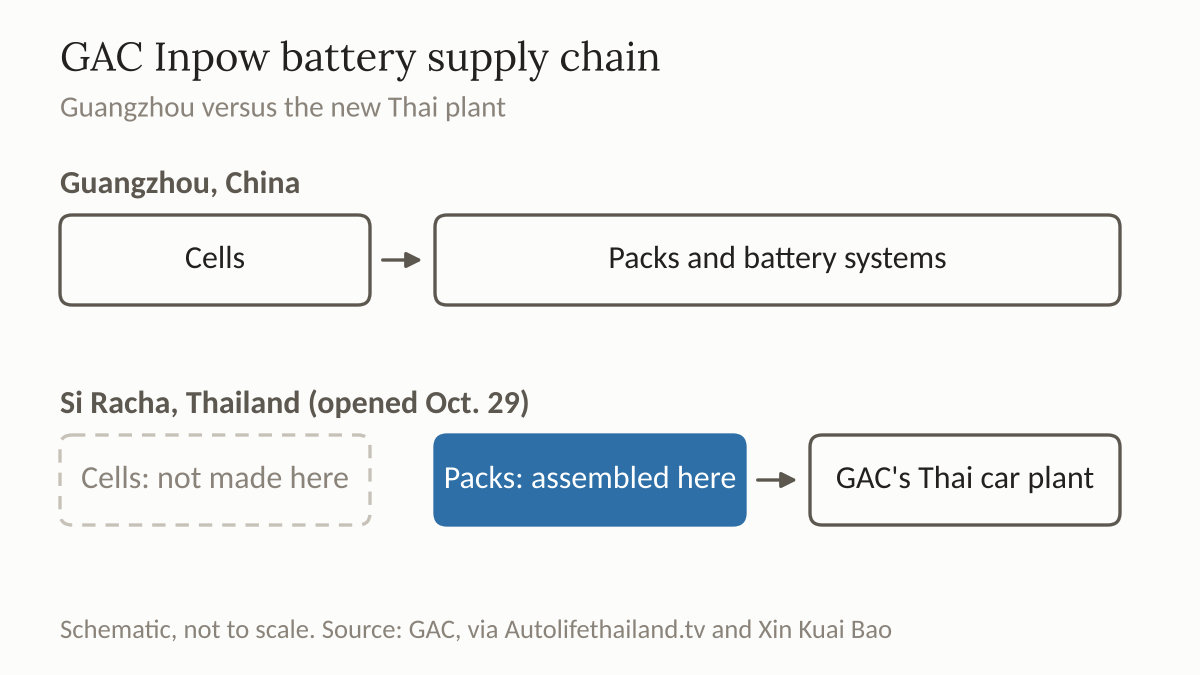
GAC Group (广汽集团), the Guangzhou-based carmaker, has started assembling electric-car battery packs in Thailand. Its in-house battery maker, GAC Inpow (因湃电池科技有限公司), opened its first plant outside China on Oct. 29 in Si Racha, in Chonburi province southeast of Bangkok. The plant does the last step of battery making, assembling packs largely from parts bought in Thailand. However, the assembly does not include cell manufacturing, an industry Thailand's government has been trying to attract.
GAC's investment in the plant totals more than 50 million yuan (about US$7.4 million), and it covers more than 13,000 square meters (about 140,000 square feet), GAC said in a Thai-language release reported by Autolifethailand.tv. Its packs will go first to GAC's car assembly plant in neighboring Rayong province, which opened in 2024. GAC says 78.9% of the plant's materials and parts are sourced in Thailand, a share it plans to raise. None of the accounts of the opening we read gave the plant's capacity or said where its cells come from.
At the opening, GAC Inpow's general manager said that the company can develop and make its batteries in-house, from cells to complete battery systems. Many carmakers' own battery work stops at pack integration and battery-management software, with cells bought in, while GAC covers materials, cells and packs, Feng Yu (冯煜), a vice president of GAC's Hyptec and Aion car business, told Xin Kuai Bao (新快报).
Pack plants have followed Chinese car plants to Thailand before. Hasco-CP, a joint venture between a Chinese car-parts maker and Thailand's Charoen Pokphand Group, began making packs in Chonburi in November 2023, mainly for SAIC Motor-CP, the Thai joint venture of SAIC Motor and Charoen Pokphand, Just Auto reported.
Thailand has also been tightening its rules on imported cells: in a November 2025 release, the Board of Investment said they could count toward carmakers' local-content requirements for six more months, to June 30, 2026, and from Jan. 1, 2026 for no more than 10% of a car's factory price, down from 15%. In November 2025, Nation Thailand reported that most battery investment in the country was still in pack or module assembly, while the government's real target was cell making.
Sources: 电池网 itdcw, 新浪汽车 Sina Auto, Autolifethailand.tv, 新快报 Xin Kuai Bao (via Sina Finance), Thailand Board of Investment (press release 168/2568), Nation Thailand, Just Auto, IT之家 ITHome (via iFeng)
Editor: Ian Lamont