Efort's robot revenue jumps 77%, but it still loses money
Efort ranked fifth by industrial robots sold in China in the first half, foreign brands included, up from seventh in 2025.

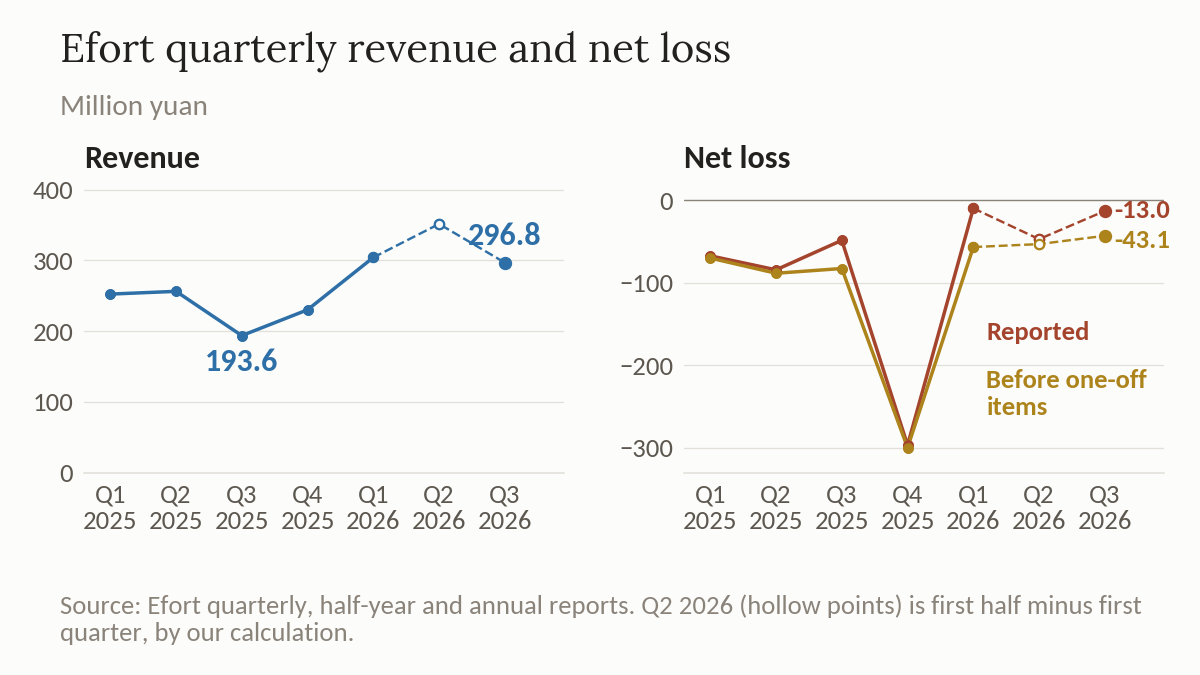
Efort (埃夫特), an industrial-robot maker based in Wuhu, in China’s Anhui province, says revenue from its robot business rose 77.3% in the third quarter from a year earlier. That helped lift total revenue 53.3% to 296.8 million yuan (about US$44.2 million), which the company credits to a recovery in both robot sales and systems-integration work.
Efort’s gross margin rose to 18.7% from 8.7%, and its net loss narrowed 73.2% to 13.0 million yuan (about US$1.9 million), its third-quarter report shows.
That loss is flattered by one-off items, including 68.0 million yuan (about US$10.1 million) of government grants. Before one-off items, Efort lost 43.1 million yuan (about US$6.4 million) in the quarter. That’s 47.9% less than a year earlier, but more than three times the reported loss.
Efort’s robot business covers industrial robots and what it calls embodied-intelligence robots, such as humanoid, four-legged and wheeled models. It didn’t report the business’s revenue for the quarter.
In its first-half report, Efort said it was focusing on carmaking, auto parts and lithium batteries, industries that demand more of a robot maker's brand and products. It said battery makers including CATL and BYD had placed volume orders. Its heavy welding robots entered the main body-welding line of a leading Chinese maker of electric and plug-in hybrid vehicles.
Chinese brands supplied 55% of the 354,000 industrial robots installed in China in 2025, according to the International Federation of Robotics. Efort ranked fifth by industrial robots sold in China in the first half, foreign brands included, up from seventh in 2025, according to rankings by market researcher MIR (睿工业) that Efort cited in its first-half and annual reports. Efort's first-half report said Chinese and foreign robot makers had both stepped up their push, that competition in China's industrial-robot market "remains severe" and that price cutting "has not noticeably eased."
Sources
- 埃夫特 Efort (SSE filing, Q3 2026 report)
- 埃夫特 Efort (SSE filing, 2026 half-year report)
- 埃夫特 Efort (SSE filing, 2025 annual report)
- 国际机器人联合会 International Federation of Robotics
- 埃夫特 Efort (company website)
Editor: Ian Lamont