China mandates robots used in PVC supply chain, but maker Boshi cites weak demand
Boshi's annual report says weaker profits at customers in these industries have curbed their ability to invest in the short term.

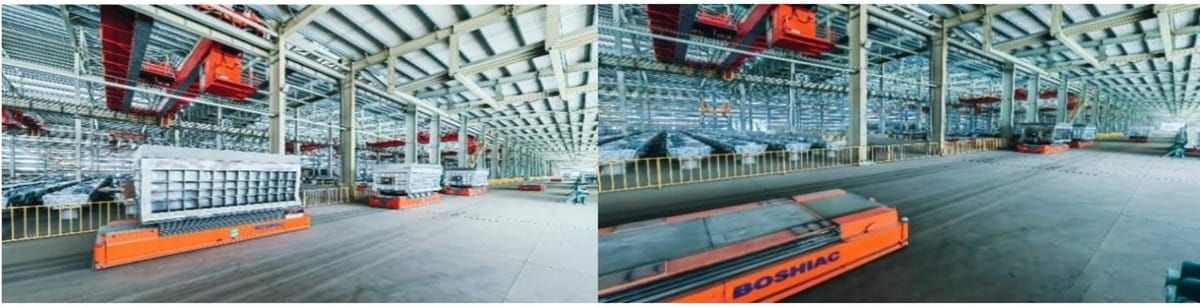
A mandatory national standard in force since Sept. 1 requires calcium-carbide plants in China to use robots to tap their furnaces, according to Harbin Boshi Automation (博实股份), which makes the robots. Boshi told investors on Oct. 16 that future demand for its furnace robots "has yet to be released."
Calcium carbide is used mainly to make polyvinyl chloride (PVC), a material widely used in the construction industry to make pipes and other building supplies. Tapping lets molten carbide run out of the furnace. Boshi's 2025 annual report says the standard requires tapping robots that open and plug the taphole.
Boshi's "robot+" line covers its furnace robots and carbide smart factories. The line's revenue fell 91.5% to 33.1 million yuan (about US$4.9 million) in 2025 from 391.4 million yuan in 2024, and its share of Boshi's revenue shrank from 13.7% to 1.2%. Boshi said the line booked no carbide smart-factory revenue that year and less revenue from its furnace robots. Its 2024 revenue included two smart-factory projects for handling finished carbide, for Inner Mongolia Junzheng Chemical (内蒙古君正化工有限责任公司) and Yinglite (宁夏英力特化工股份有限公司), signed in 2022 for about 360 million yuan (about US$54 million) combined, including tax, according to an investor record.
In the first half of 2026, the line's revenue rose 125.8% from a year earlier to 48.2 million yuan (about US$7.2 million). The half-year report credited the rise to deliveries of robots for ferrosilicon, silicomanganese, industrial-silicon and other furnaces, plus a ferrosilicon casting machine. It did not mention carbide.
Asked on Sept. 7 about carbide tapping-robot orders, Boshi gave no figure. On Oct. 16 it told investors that a full recovery in customer demand "must rest on customers' profitability continuing to improve."
Boshi's annual report says weaker profits at customers in these industries have curbed their ability to invest in the short term. Yinglite, which makes PVC and caustic soda, reported a net loss of 246.8 million yuan (about US$36.8 million) for the first half of 2026, up from 155.6 million yuan a year earlier, its half-year report shows.
The standard, overseen by the Ministry of Emergency Management, comes amid a wider push on chemical safety. China's national emergency-management work conference in January named calcium-carbide production among six chemical processes where it wants to develop "smart, unmanned" operations, Boshi's annual report says. Jiemian reported in July that PVC makers were still in a cyclical trough.
Sources: 博实股份 Boshi (2025 annual report, cninfo filing via eastmoney), Harbin Boshi Automation (2025 annual report abstract, English, cninfo), 博实股份 Boshi (2026 half-year report, cninfo), 博实股份 Boshi (investor-relations record, cninfo), 博实股份 Boshi (互动易 reply, SZSE) [1], [2], [3], 全国标准信息公共服务平台 National Public Service Platform for Standards Information (SAMR), 英力特 Yinglite (2026 half-year report summary, cninfo), 界面新闻 Jiemian
Editor: Ian Lamont