CATL seals deals to expand two-battery swap system for trucks
CATL says its new setup splits a truck's battery in two, so drivers can run the leased main pack nearly flat.

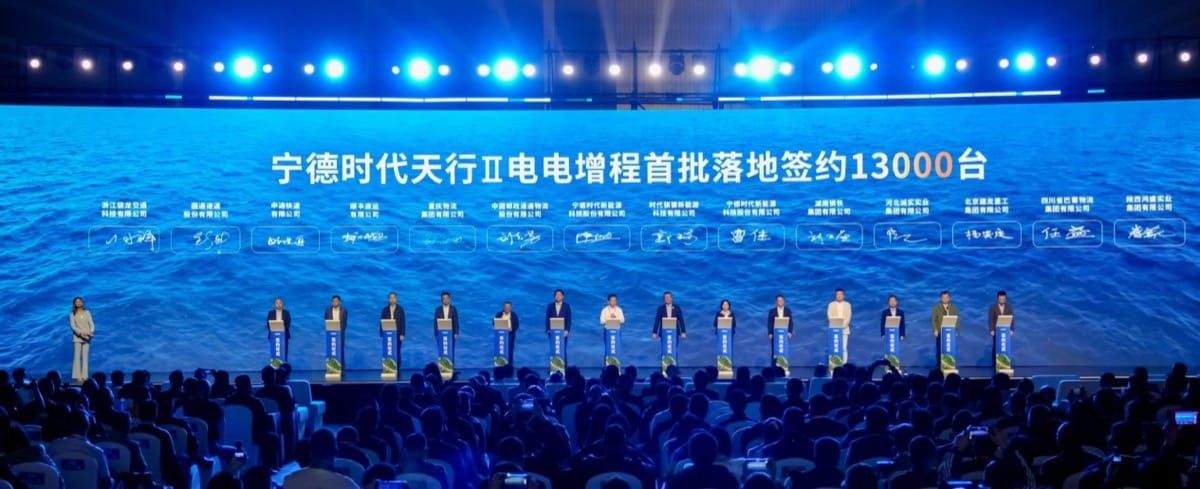
Parcel carriers China Post, SF Express (顺丰速运), STO Express (申通快递) and YTO Express (圆通速递) signed agreements with CATL, the world's largest electric-vehicle battery maker, for heavy trucks using its new two-battery swap system, the company announced. Two steel groups, two regional logistics firms and others also signed. The agreements cover a first batch of 13,000 trucks, signed at CATL's Oct. 20 launch in Beijing.
The same day, 14 truck makers and dealers, including FAW Jiefang (一汽解放), Sinotruk (中国重汽) and Sany (三一), joined CATL in launching a partnership around Qiji (骐骥), its battery-swap service for heavy trucks.
The system, a version of CATL's Tianxing II (天行Ⅱ) truck battery, splits the truck's battery into two packs that work independently. The main pack, 432 or 513 kWh, sits under the chassis, is leased rather than bought, and is swapped at CATL’s Qiji stations in about five minutes. A smaller 77 kWh pack stays on the truck as a backup, and the truck switches to it automatically when the main pack runs low.
Because of the backup, drivers can run the main pack down to below 5% charge before swapping, CATL says, compared with about 30% for conventional swap trucks. CATL estimates a truck covering 400 km (about 250 miles) per day saves 130,000 yuan (about US$19,500) per year on energy compared with a diesel truck.
CATL said its Qiji network will have 900 heavy-truck swap stations by the end of 2026 and 2,000 in 2027. It set the same year-end target in April, saying it had more than 300, CnEVPost reported. It gave no current count.
The launch comes as electric heavy trucks gain ground in China. New-energy heavy trucks (China's term for battery-electric, plug-in hybrid and fuel-cell vehicles) were 50% of the segment in September, up from 29% a year earlier, according to China Passenger Car Association analysis of compulsory traffic insurance data reported by CnEVPost. Wang Jingzhu (王静竹), CATL's executive president for heavy industry, said that as the system and the Qiji network spread, battery swapping will come to share the market with charging.
Sources: CATL (宁德时代) release, 商用车界 (CATL release text, via Sohu), 界面新闻 Jiemian, Sohu (CATL release text), 凤凰网 ifeng (CATL release text), CnEVPost [1], [2]
Editor: Ian Lamont