CALB gains on CATL as China's nickel-based batteries slump
Installations of nickel-based cells in China's vehicles fell 22.8% from a year earlier in October, an industry group says.

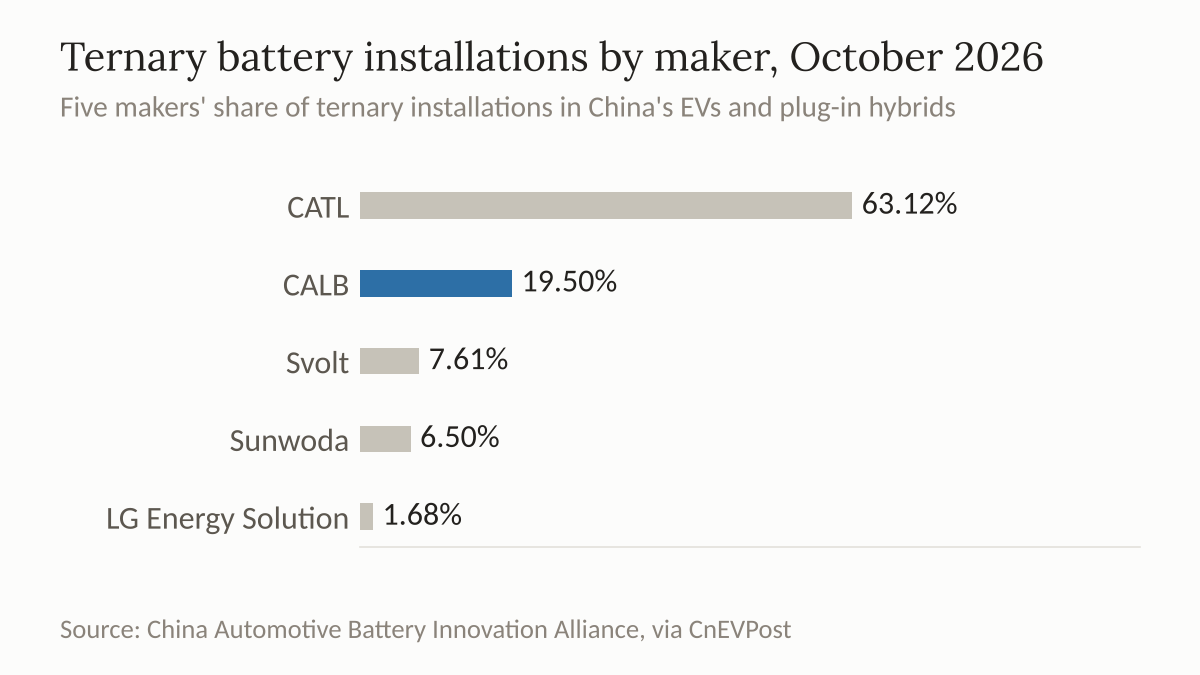
Nickel-based (ternary) batteries are losing ground in China's electric and plug-in hybrid vehicles, and CALB (中创新航), a battery maker in Changzhou, in eastern China, is taking a bigger slice of what remains. Its share of ternary installations rose 8.3 percentage points from September to 19.5% in October. Market leader CATL slipped 4.7 points to 63.1%, according to the China Automotive Battery Innovation Alliance (中国汽车动力电池产业创新联盟), an industry group.
The alliance's monthly figures, which the tech news site ITHome (IT之家) summarized, count batteries installed in vehicles in China. Ternary installations fell 22.8% from a year earlier to 12.8 gigawatt-hours (GWh) in October, after a 10.9% drop in September. Lithium iron phosphate (LFP) cells made up 86.9% of the 99.4 GWh installed, up from 85.5% in September.
LFP cells, whose raw materials cost less, keep taking market share, while ternary cells retreat to high-end long-range models and cold northern regions, the Economic Observer (经济观察网) reported.
CATL took 40% of all installations in October, down 0.9 points from September, the trade site CnEVPost reported, citing the alliance. The slip came mainly in ternary cells, the Economic Observer said. From January through October, though, CATL's share was 43.6%, up 0.8 points from a year earlier, according to CnEVPost.
Second-place BYD, whose installations are all LFP, raised its share 0.3 points from September to 21.4%. That narrowed its gap with CATL for a fifth straight month, according to CnEVPost. CALB ranked third overall with 8.6%, up 1.7 points from September.
Other makers' ternary shares in October, with the change from September:
- Svolt (蜂巢能源): 7.6%, up 1.3 points.
- Sunwoda (欣旺达): 6.5%, up 3.2 points.
- South Korea's LG Energy Solution: 1.7%, down 7.5 points, falling from third to fifth.
Carmakers have tied themselves more tightly to second-tier cell makers since 2025, through joint plants, stakes and dedicated production lines, the Economic Observer reported. Under a strategic deal with Xiaomi, the carmaker defines the battery products, and CALB develops and makes custom ternary cells for them.
Sources
Editor: Ian Lamont