Chip-testing firm Ardentec borrows amid factory spending surge
A Nov. 17 filing shows the buying continued after spending outran operating cash flow through September.

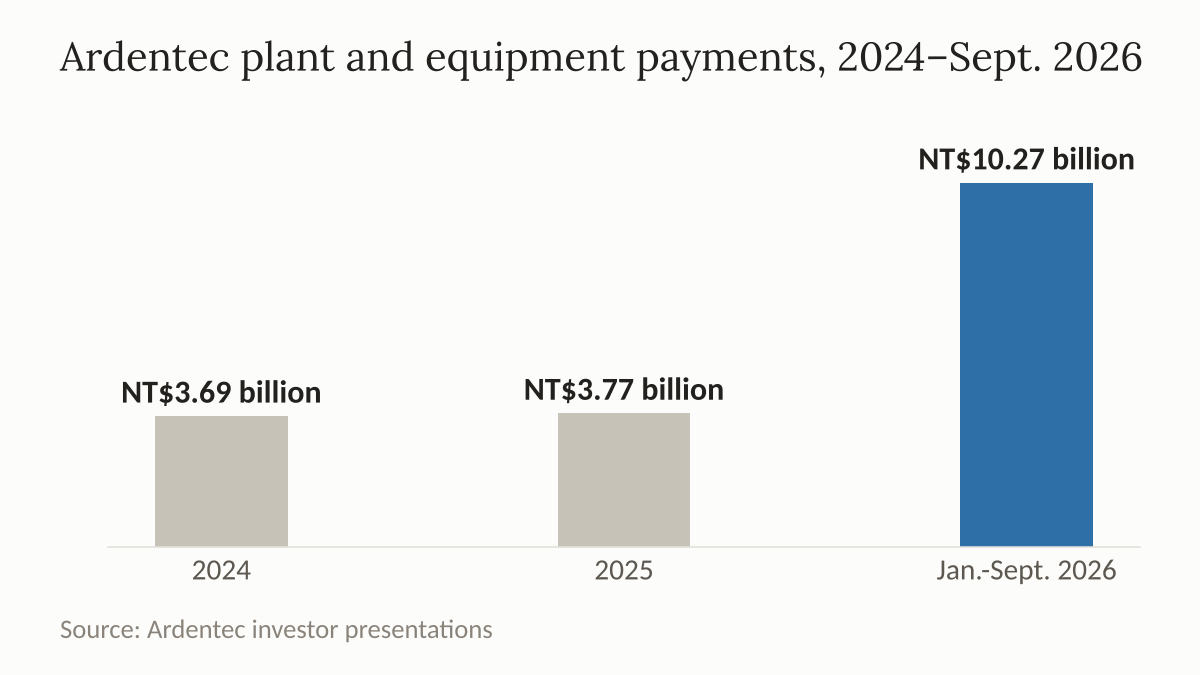
Ardentec (欣銓科技), a chip-testing company in Hsinchu County, Taiwan, spent more than 3.6 times as much on plant and equipment in the first nine months of 2026 as a year earlier. The spending has outrun its operating cash flow, and its bank borrowing has jumped.
Ardentec paid NT$10.27 billion (about US$316 million) for plant and equipment in the nine months, up from NT$2.80 billion a year earlier and well above the NT$3.77 billion it paid in all of 2025, based on the company’s figures. Its 2025 revenue was NT$14.03 billion (about US$432 million).
The buying has continued into the fourth quarter. A Nov. 17 filing shows NT$1.08 billion (about US$33 million) of production machinery bought between Sept. 9 and Nov. 17 from the Taiwan arm of Advantest, a Japanese maker of chip test equipment. It doesn't give the machines' type or number.
Ardentec's third-quarter investor presentation shows how the spending was paid for. Its capital spending exceeded its operating cash by NT$5.12 billion (about US$158 million) in the nine months, its third-quarter investor presentation shows. Over the same period it took on a net NT$6.14 billion (about US$189 million) in new bank loans, about 11 times the amount a year earlier.
The spending comes as the business grows. Ardentec's revenue rose 36.8% from a year earlier to NT$15.71 billion (about US$484 million) in January through October, according to monthly revenue reports. That was faster than three other Taiwan chip-test and packaging companies: KYEC (京元電子), excluding discontinued operations, rose 33.5%, ChipMOS (南茂) 30.5% and Sigurd (矽格) 21.2%.
Ardentec's Nov. 17 filing doesn't say which customers the machinery will serve or which plant will get it. Foundries, which make chips for other companies, were 5.4% of Ardentec's nine-month revenue, up from 1.8% a year earlier. Its plant in Longtan, Taoyuan, began volume production in July, and Commercial Times (工商時報) reported that month that the plant would work more closely with chip-fabrication plants.
Sources